Mushroom Pool: The subtle spring with the spectacular story - Caldera Chronicles
By Yellowstone Volcano Observatory March 9, 2026
Mushroom Pool is nondescript in appearance, but its impacts on microbiology and on how research is done in Yellowstone National Park have been profound.
Yellowstone Caldera Chronicles is a weekly column written by scientists and collaborators of the Yellowstone Volcano Observatory. This week's contribution is from Michael Poland, geophysicist with the U.S. Geological Survey and Scientist-in-Charge of the Yellowstone Volcano Observatory.
Mushroom Pool is a small hot spring in Yellowstone’s Lower Geyser Basin that looms large in science. The spring’s fun(gi) name might have been given in the 1890s due to its appearance or the presence of algae and bacteria.
Media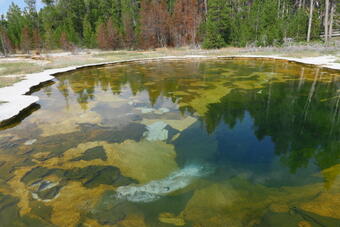
Sources/Usage: Public Domain. View Media Details
Despite being apparently unremarkable compared to other Yellowstone hot springs, Mushroom Pool is the site of an extraordinary scientific discovery that has had a global impact and also shaped how research is done in the world’s first National Park.
The story begins in 1964, when Dr. Thomas Brock, a microbiologist from Indiana University, vacationed in Yellowstone National Park and was intrigued by the life that was clearly thriving in Yellowstone’s hot springs. He returned to Yellowstone in 1965 with his wife Louise (also a microbiologist) to gain field experience prior to work on potential bacterial colonization of the new volcanic island of Surtsey, off the south coast of Iceland. It was clear, however, that there was much to be learned in Yellowstone itself.
The serious work began in August 1966, when Brock was joined in Yellowstone by colleagues and students, including Hudson Freeze, then an undergraduate at Indiana University. They visited numerous thermal features in the Lower Geyser Basin and collected samples of bacteria from springs that had a neutral to alkaline (basic) pH. One of those springs was Mushroom Pool.
A month later, back in the laboratory, Freeze managed to isolate bacteria from the Mushroom Pool sample—a bacteria now known as Thermus aquaticus (nicknamed “Taq”) for the warm water in which it lived. They published their findings in the Journal of Bacteriology in 1969 and cataloged the bacteria in the American Type Culture Collection—a sort of repository for microorganisms. The work served as Freeze’s undergraduate honors thesis and must rank as one of the most spectacular and consequential undergraduate research projects ever!

In 1983, Kary Mullis, a biochemist working for a company in Berkely, California, realized that Taq contained heat-resistant components that were essential for copying small amounts of DNA, thereby allowing DNA analyses to be conducted more easily. The technique he developed, called Polymerase Chain Reaction (PCR), is used today for crime scene investigations, genetic testing, medical diagnoses (like COVID-19), and much more. Mullis received the Nobel Prize in 1993 for his work, and in 2013 Thomas Brock and Hudson Freeze were recognized with a “Golden Goose Award,” highlighting the tremendous societal benefits of their discovery.
Of the more than 10,000 thermal features in Yellowstone National Park, why did Brock and Freeze focus on Mushroom Pool? Why not the more charismatic Morning Glory Pool or Grand Prismatic Spring?
Collecting biological samples from hot springs often requires leaving equipment on site and undisturbed for days to months. Mushroom Pool was off the beaten path and not a visitor destination, but it was close enough to a road to be accessible to researchers.
Although Brock had a research permit, guidance on how to work in delicate areas was lacking. Brock became one of the first to advocate for leaving locations as they were found—to ensure research equipment was not obvious and that all signs of the work were removed when the research was done. This important practice is now standard for scientists who work in Yellowstone.

In the years since the discovery made by Thomas Brock and Hudson Freeze, Mushroom Pool has inspired scientists and non-scientists alike. During a visit to Yellowstone in 2007, Freeze, who earned a Ph.D. in 1976 and is now the Director of the Sanford Children’s Health Research Center at Sanford Burnham Prebys, was eating lunch not far from the hot spring he helped to make famous. An approaching visitor, unaware of who Freeze was, asked him if he knew where the pool with the famous bacteria was located. Freeze gestured in the direction of Mushroom Pool. “It’s right over there.” The visitor was skeptical. “Are you sure?” Freeze, who is a great fan of Indiana Jones, smiled and said, “Pretty sure…” He wasn’t going to miss the opportunity to use that line. It was an appropriate response—the story of Mushroom Pool is akin to the discovery of a scientific grail.
ACKNOWLEDGEMENTS: Material for this article was drawn from Lee. H. Whittlesey’s book Yellowstone Place Names, Geothermal Biology and Geochemistry in Yellowstone National Park (edited by William Inskeep and Timothy McDermott), A scientist in Yellowstone by Thomas Brock (https://uwmadison.app.box.com/s/h9def9ehidlu7n51s2ls3tfrqber4ij8), and a personal interview with Dr. Hudson Freeze, to whom the Yellowstone Volcano Observatory is especially grateful.
Authors
Authors
